Rowing looks simple from the outside: sit down, pull the handle, slide forward, repeat. But if you’ve ever finished a rowing workout and felt sore in places you didn’t even expect—like your upper back, glutes, or even your forearms—you’ve probably wondered what muscles does rowing work exactly?
And more importantly… is rowing actually a full-body workout, or is it just cardio?
This is a common question because rowing doesn’t “burn” the way running does. You’re not pounding the ground, and your breathing might feel controlled—until you suddenly realize your legs are shaking, your back is tight, and your core feels like it’s been doing crunches for 20 minutes.
This article breaks down what muscles rowing works out, which ones get hit the most, and why rowing feels different from other exercises. You’ll also learn how your rowing form changes which muscles do the work—and how to fix common mistakes so you don’t turn rowing into a “back-only” workout.
The Short Answer: What Muscles Does Rowing Work?
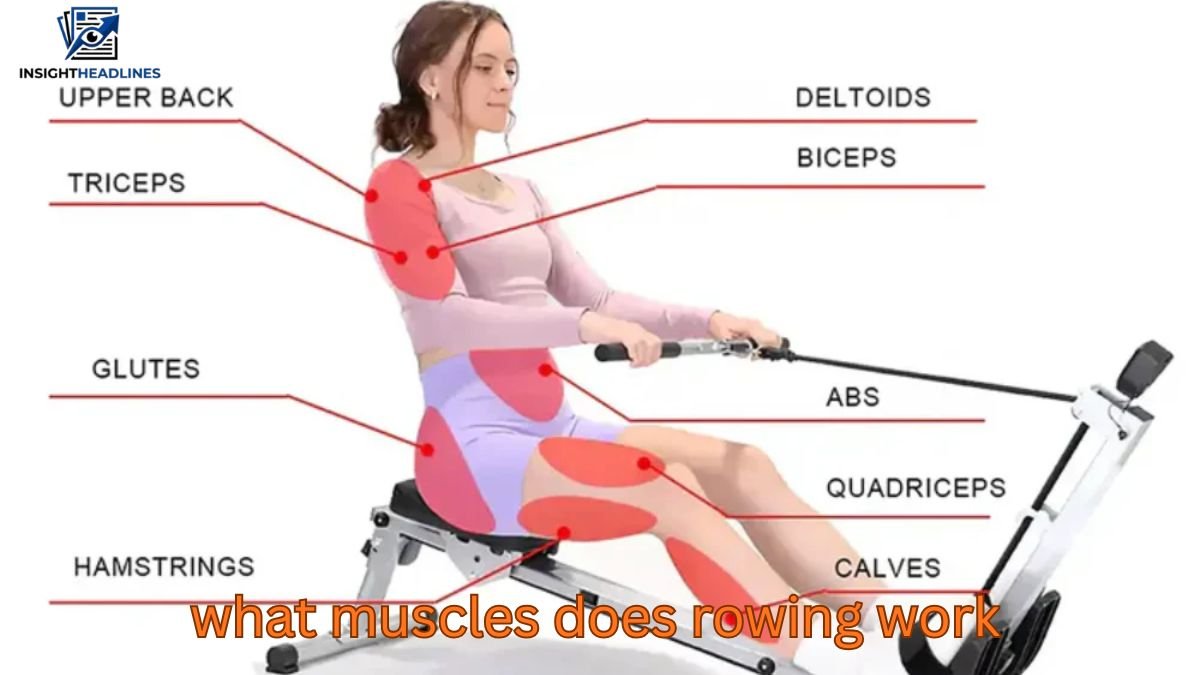
Rowing works nearly your entire body, but the biggest muscle groups involved are:
- Quadriceps (front thighs)
- Glutes (butt muscles)
- Hamstrings (back thighs)
- Core (abs and deep stabilizers)
- Lats (wide back muscles)
- Upper back (rhomboids, traps)
- Shoulders (deltoids)
- Biceps and forearms
In real terms: rowing is about legs driving power, the core transferring force, and the upper body finishing the pull.
Is Rowing Upper Body or Lower Body? (Most People Get This Wrong)
If you ask someone on Reddit “what muscles does rowing work the most?” you’ll usually see two opinions:
- “Rowing is mostly legs.”
- “Rowing destroys my back and arms.”
Both are true—but only one is correct if your form is good.
Rowing is mostly legs (when done correctly)
In proper rowing technique, about 60% of the power comes from your legs, about 20% from your core/hips, and about 20% from your arms and upper back.
So if rowing feels like an arm workout, it’s usually a sign that you’re pulling too early instead of driving with your legs first.
Real-world example:
If your arms feel tired before your legs do, you’re likely “curling” the handle instead of using your quads and glutes.
The Rowing Stroke: Which Muscles Work in Each Phase
To truly understand what muscles rowing works on, you need to break down the rowing stroke into phases. Each phase emphasizes different muscles.
1. The Catch Position (Start of the Stroke)
This is when you’re compressed forward with knees bent.
Muscles engaged here:
- Core stabilizers (deep abs)
- Hip flexors
- Hamstrings under stretch
- Upper back stabilizers
You’re not producing power yet—you’re loading tension like a spring.
2. The Drive (The Power Phase)
This is where most of your calories burn and most of your muscle activation happens.
Main muscles used:
- Quadriceps (biggest driver)
- Glutes (hip extension power)
- Hamstrings (support and stabilization)
- Core (keeps the spine braced)
Think of it like a horizontal squat.
Key point:
If your heels come up too much or your knees collapse inward, your quads will work harder while your glutes contribute less.
3. The Finish (Pull and Squeeze Phase)
When your legs are extended and the handle comes to your lower ribs.
Muscles worked most here:
- Lats (pulling power)
- Rhomboids (shoulder blade squeeze)
- Traps (upper back control)
- Rear delts (back shoulders)
- Biceps and forearms
This is the part that makes rowing feel like a back workout.
4. The Recovery (Return Phase)
Sliding forward again.
Muscles involved:
- Core control (stability)
- Hip flexors (bringing knees back in)
- Lower back stabilizers
- Hamstrings controlling the slide
The recovery isn’t “rest” if you’re rowing correctly—it’s controlled movement that keeps tension in the body.
What Muscles Does Rowing Work Out the Most?
Rowing activates many muscles, but the muscles that get hit the hardest are:
1. Quadriceps
Your quads do most of the driving, especially at the beginning of the stroke. If your rowing machine workouts include high resistance, quads will burn fast.
2. Glutes
Glutes kick in strongly as you extend your hips. Strong glutes are what give rowing that “powerful” look.
3. Lats
The lats are heavily involved in the pulling motion. They’re one of the biggest muscles in your upper body, which is why rowing can shape your back.
4. Core
Not just abs—the core includes deep stabilizers, obliques, and lower back muscles. Rowing forces your torso to resist collapsing under repeated tension.
What Muscles Does Rowing Work in the Back?
Rowing is one of the best cardio-based exercises for back development because it targets multiple back layers at once.
Upper Back Muscles Used in Rowing
- Rhomboids (pull shoulder blades together)
- Trapezius (especially mid traps for posture)
- Rear deltoids (back of shoulders)
Mid/Lower Back Muscles Used
- Lats (main pulling muscle)
- Erector spinae (stabilize spine and posture)
Important note:
Rowing strengthens your back mostly through repeated posture control, not heavy compression like deadlifts. That’s why it can improve posture if done properly.
What Muscles Does Rowing Work in the Arms?
Rowing works your arms, but they are not the primary movers. Still, they get plenty of volume.
Arm Muscles Activated
- Biceps (handle pull at finish)
- Forearms (grip strength and endurance)
- Brachialis (deep elbow flexor)
- Triceps (stabilizing the push at the finish)
If your forearms burn quickly, it often means you’re gripping too hard or bending your arms too early.
What Muscles Does Rowing Work in the Core?
Rowing is sneaky-core training. You don’t feel it like crunches, but it’s constantly working.
Core Muscles Used
- Rectus abdominis (front abs)
- Transverse abdominis (deep core brace)
- Obliques (rotation resistance)
- Lower back stabilizers
Why rowing is so effective for the core:
Your torso has to stay stable while your legs generate force and your arms pull. That force has to travel through your midsection like a bridge.
If your core collapses, your lower back takes over.
What Muscles Does Rowing Work in the Legs?
Rowing is basically leg training disguised as cardio.
Leg Muscles Used in Rowing
- Quads: main driver off the catch
- Hamstrings: control and hip extension support
- Glutes: hip drive and power
- Calves: stability and foot pressure
If you row with higher stroke power, you’ll feel it in your legs the next day almost like a squat workout.
Is Rowing Good for Glutes?
Yes—rowing is surprisingly good for glutes, but only if you row correctly.
How to Make Rowing Hit Glutes More
- Drive through heels, not toes
- Keep knees tracking straight (don’t collapse inward)
- Focus on hip extension at the finish
- Avoid leaning back too early
Real-life clue:
If your quads always dominate and glutes never feel sore, your form is likely too knee-heavy and not hip-driven.
Is Rowing Good for Abs? (Yes, But Not Like You Think)
Rowing can strengthen abs and flatten the waistline over time, but it’s not a “six-pack builder” unless your diet is dialed in.
Rowing works your abs mainly through:
- bracing
- posture control
- resisting forward collapse
It’s similar to how planks work—less burn, more stability.
Practical truth:
If you want visible abs, rowing helps burn fat and strengthens your core, but you’ll still need nutrition and overall strength training.
Does Rowing Build Muscle or Just Burn Calories?
Rowing can build muscle, but it depends on how you row.
Rowing Builds Muscle When:
- resistance is moderate to high
- you row with strong leg drive
- you keep workouts intense but controlled
- you progressively increase pace or duration
Rowing is Mostly Cardio When:
- resistance is low
- strokes are fast but weak
- you “flail” with arms instead of driving with legs
Best approach:
If your goal is muscle tone, use rowing like interval training—short hard bursts with rest.
Rowing Machine vs Real Rowing: Do Muscles Change?
The muscles are mostly the same, but real rowing adds extra demands.
Real rowing activates more:
- stabilizers in hips
- balance muscles
- grip endurance
- rotational core control (especially in water conditions)
Rowing machines are more controlled and symmetrical, which is great for beginners and fitness goals.
Common Rowing Mistakes That Change Which Muscles Get Worked
Most people don’t realize they’re shifting the workload to the wrong muscles until soreness tells them.
Mistake 1: Pulling with Arms First
This turns rowing into a bicep/shoulder workout and reduces leg power.
Fix:
Push with legs first. Arms stay straight for the first half of the drive.
Mistake 2: Rounding the Back
This overloads the lower back and reduces core engagement.
Fix:
Chest up, spine neutral, core braced.
Mistake 3: Leaning Back Too Far
This creates stress on the lower spine and makes rowing inefficient.
Fix:
Slight lean only (around 10–15 degrees).
Mistake 4: Slamming the Seat Forward
This reduces control and makes recovery sloppy.
Fix:
Slow recovery, controlled slide forward.
Practical Rowing Tips to Target Muscles Better
If you want rowing to feel like a full-body workout (instead of “random fatigue”), small changes matter.
Technique Tips That Make a Huge Difference
- Keep your arms relaxed until the legs finish driving
- Think: legs → hips → arms
- Keep shoulders down (avoid shrugging)
- Row smoothly, not violently
- Use a grip like holding a hook, not squeezing a stress ball
A Simple Cue That Works
“Push the machine away with your feet.”
That one sentence fixes 80% of beginner rowing form issues.
Unique Insight #1: Rowing Is a “Force Transfer” Exercise
Most articles say rowing works legs, back, and arms—but they miss the deeper point:
Rowing is one of the best exercises for teaching your body to transfer power through the core.
Your legs create the power, but your torso must stay stiff enough to transfer it into the handle pull. This is why athletes (fighters, runners, football players) often use rowing as conditioning.
It’s not just cardio—it’s coordination training.
Unique Insight #2: Your Foot Strap Tightness Changes Muscle Activation
This is rarely mentioned, but it matters a lot.
- If straps are too tight, people tend to pull themselves back using hip flexors and lower back.
- If straps are too loose, you’re forced to push through heels and engage glutes more.
A good rule: straps should hold your feet in place, but you should still be able to lift your heel slightly without pain.
This small adjustment can shift rowing from “quad burn” to a more balanced glute/core workout.
Unique Insight #3: Rowing Can Reveal Weak Glutes or Tight Hips
Rowing exposes imbalances fast.
If your lower back gets sore quickly, it often means:
- glutes aren’t firing properly
- hips are tight
- core is weak
- posture collapses during fatigue
Rowing isn’t causing the weakness—it’s exposing it.
This is why rowing is sometimes used in rehab settings (carefully) because it shows how the body compensates under repeated motion.
Rowing Workout Styles and Which Muscles They Emphasize
Different rowing styles stress muscles differently.
Long Steady Row (20–40 minutes)
Best for:
- endurance
- fat loss
- posture muscles (upper back)
- core stability
Sprint Intervals (20–60 seconds hard)
Best for:
- quads and glutes
- lats and upper back
- cardio capacity
Heavy Resistance Rowing (low stroke rate)
Best for:
- leg strength
- glute activation
- back thickness feel
If your goal is toning and muscle definition, intervals + moderate resistance usually give the best results.
Is Rowing Better Than Running for Full-Body Fitness?
Rowing and running are both great cardio, but rowing has two major advantages:
- It works upper body and core more than running.
- It’s lower impact on knees and joints.
Running mainly targets:
- calves
- quads
- hamstrings
- glutes
Rowing targets those plus:
- lats
- shoulders
- arms
- upper back
So if your question is what muscles does rowing work out compared to running, rowing wins for total-body engagement.
FAQ: What Muscles Does Rowing Work?
What muscles does rowing work the most?
Rowing works the legs the most, especially the quads and glutes, because the drive phase generates most of the power. The lats and upper back come next as you finish the pull. Your core works continuously to stabilize your posture and transfer force. If your arms feel like they’re doing everything, your form likely needs adjustment.
What muscles does rowing work on the rowing machine?
A rowing machine works the quads, hamstrings, glutes, core, lats, upper back, shoulders, and arms. It’s a true full-body movement because it combines a leg press, hip hinge, and pulling motion. Unlike many cardio machines, rowing includes strong back and core involvement. The harder you drive with your legs, the more full-body it becomes.
Does rowing work abs or is it mostly back?
Rowing absolutely works abs, but more in a stabilizing way than a crunching way. Your abs brace your spine and prevent your torso from collapsing during the drive. Your back muscles also work heavily, especially the lats and upper back. If you row with good posture, abs and back work together as a unit.
Why do my arms get tired first when rowing?
This usually happens when you pull with your arms too early instead of driving with your legs first. Your biceps are smaller muscles, so they fatigue quickly if they’re forced to do the main work. Focus on keeping arms straight during the first part of the drive. Think of your arms as hooks until the legs finish pushing.
Is rowing good for building muscle?
Rowing can build muscle, especially in the legs, glutes, and upper back, but it depends on intensity and resistance. Sprint intervals and higher resistance rowing activate muscle fibers more than easy steady rowing. It won’t replace heavy weight training, but it can definitely improve muscle tone and endurance. Many people notice stronger legs and a more defined back after consistent rowing.
What muscles does rowing work for weight loss?
Rowing works large muscle groups like the legs, glutes, and back, which increases calorie burn and supports fat loss. Because it’s full-body, it burns more calories than many cardio machines at the same effort level. It also builds muscular endurance, which helps you train harder over time. For weight loss, interval rowing combined with a calorie-controlled diet is especially effective.
Conclusion: Rowing Works More Than You Think
So, what muscles does rowing work? The honest answer is: almost everything. Your legs drive the power, your glutes and hamstrings support hip extension, your core transfers force, and your back and arms finish the pull.
But the biggest difference between rowing that “feels okay” and rowing that transforms your body comes down to one thing: technique. If you row with the correct sequence—legs first, core second, arms last—you’ll feel balanced soreness across your legs, glutes, back, and abs.
If you want one takeaway, make it this: rowing isn’t an arm exercise and it isn’t just cardio—it’s a full-body power movement that rewards good form.