
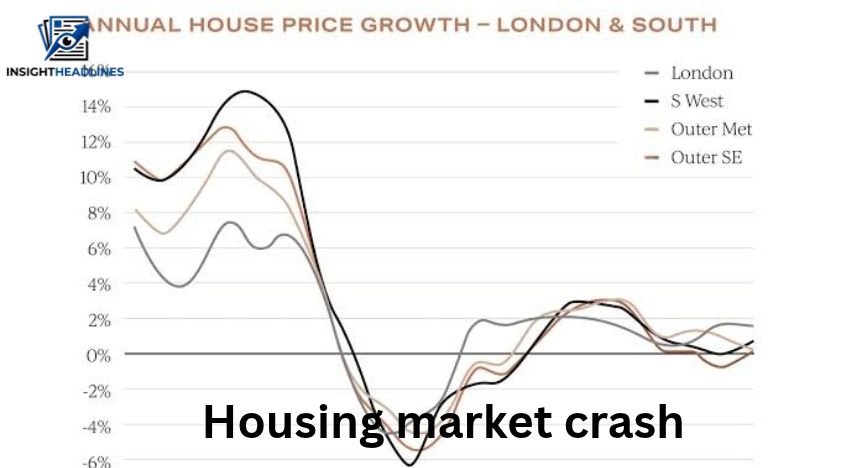
The possibility of a UK housing market crash is a concern for homeowners, first-time buyers and property investors. After years of affordability pressures, higher mortgage costs and changing economic conditions, many people are questioning whether property prices could experience another major decline. Some buyers are delaying purchases in the hope of finding cheaper homes, while existing homeowners are concerned about losing the value built up in their properties.
The UK has experienced several housing downturns, including the early 1990s recession and the 2007–2009 financial crisis. However, not every period of falling house prices develops into a full-scale crash. A slowdown, a market correction and a financial crisis are different economic events.
As of November 2026, house price growth has weakened, mortgage borrowing has become more expensive and property market activity has declined. This article examines the latest figures, historical crashes, economic warning signs and housing market crash predictions. It also explains whether another major downturn is likely and what buyers and homeowners should understand before making property decisions.
What Is a Housing Market Crash?
A housing market crash is a substantial and sustained decline in property prices, usually accompanied by weaker demand, fewer property transactions and wider economic difficulties.
It can occur when house prices become disconnected from household incomes, mortgage borrowing becomes difficult to maintain or economic conditions reduce the number of people able to purchase properties.
A housing market crash generally involves several developments:
- Significant declines in average property values.
- Reduced mortgage lending and property transactions.
- Increasing mortgage arrears and repossessions.
- Higher unemployment and financial uncertainty.
- Falling buyer confidence and increased property supply.
A market correction is different. It usually involves a smaller reduction in property values as prices adjust to affordability, interest rates and demand.
For example, if a property valued at £300,000 falls to £285,000, the reduction is 5%. This represents a decline in value, but it does not automatically indicate a nationwide housing crash.
The distinction is important when examining the housing market crash UK outlook because individual monthly price declines are not enough to establish that a financial crisis is developing.
UK Housing Market Crash: What Is Happening in 2026?
The UK property market has experienced weaker conditions during 2026, with several indicators pointing towards reduced buyer confidence and pressure on house prices.
The latest available figures show different results depending on the index used.
| Source | Latest reported figures | Period |
|---|---|---|
| HM Land Registry | Average price approximately £273,000; annual growth 0.9% | August 2026 |
| Nationwide | Average price £273,566; annual growth 0.5% | October 2026 |
| Lloyds House Price Index | Average price £296,285; annual decline 1.2% | October 2026 |
The differences reflect the methods used by each organisation. Land Registry records completed transactions, while Nationwide and Lloyds use mortgage-related data.
The Bank of England’s November 2026 Monetary Policy Report also identified weaker housing activity. Mortgage approvals for house purchases fell by 8% in the three months to September compared with the previous three-month period. The report also recorded falling house prices and higher mortgage borrowing costs.
These figures indicate that the market is under pressure. However, they do not independently confirm that a major housing crash has started. <Cite refs={[“turn790958search7″,”turn790958search2″,”turn790958search6″,”turn790958search3”]}/>
Why are UK house prices under pressure?
Several economic factors are contributing to the slowdown.
Higher mortgage rates: More expensive borrowing reduces the amount many households can afford to spend on property.
Inflation: Higher living costs leave households with less disposable income for mortgage payments, deposits and other housing expenses.
Economic uncertainty: Buyers may delay major financial decisions when they are uncertain about employment, interest rates and future income.
Reduced demand: Fewer mortgage approvals can eventually translate into fewer completed property purchases.
Regional differences: Some areas are experiencing falling prices while others continue to record annual growth.
These factors can weaken the housing market without necessarily causing a financial crisis.
Will the UK Housing Market Crash?
There is no confirmed evidence that the UK is heading towards a nationwide housing crash on the scale of 2008. However, the possibility of further price declines cannot be ruled out.
The current market has several characteristics associated with a slowdown:
- Mortgage rates have increased.
- Annual house price growth has weakened.
- Mortgage approvals have declined.
- Some property indices are recording annual price falls.
- Economic uncertainty is affecting buyer confidence.
There are also factors that could prevent a more severe downturn.
Mortgage lending standards have changed since the financial crisis, and affordability assessments generally require lenders to consider borrowers’ ability to manage repayments. Many homeowners have also already experienced higher mortgage costs since 2022.
The housing market is additionally influenced by the limited availability of suitable homes in some areas. Where demand remains relatively strong and supply is restricted, prices may be more resilient.
Therefore, the current evidence supports the possibility of a prolonged period of weak prices rather than proving that another major crash is inevitable.
When Will the Housing Market Crash?
No reliable forecast can identify an exact date for a future housing market crash. Property prices depend on several interconnected economic factors, which can change considerably over time.
However, there are warning signs that economists and property researchers monitor when assessing the risk of a downturn.
1. Rising Mortgage Interest Rates
Mortgage rates are among the most important influences on property demand.
When borrowing becomes more expensive, monthly repayments increase and some buyers can no longer afford the properties they previously considered.
For example, a household planning to borrow £250,000 may find that a higher mortgage rate increases its monthly repayments by hundreds of pounds, depending on the mortgage term and product.
If mortgage costs remain high, fewer buyers may qualify for the loans required to purchase homes.
2. Increasing Unemployment
Employment stability supports mortgage payments and housing demand.
If unemployment increases, some households may struggle to meet their financial commitments. Those experiencing serious financial difficulties could be forced to sell their properties.
A widespread increase in forced sales could create additional pressure on house prices, particularly in areas where demand is already weak.
3. Mortgage Arrears and Repossessions
Mortgage arrears occur when borrowers fall behind on their repayments.
A sustained increase in arrears and repossessions could indicate that financial pressure is spreading through the housing market.
However, arrears alone do not prove that a crash is approaching. Their significance depends on how widespread the problem becomes and whether lenders can manage the resulting losses.
4. Falling Property Transactions
Property transaction numbers can provide an early indication of weakening market conditions.
When buyers become cautious, fewer homes are purchased. Estate agents may receive fewer enquiries, properties can remain on the market for longer and sellers may reduce their asking prices.
One important point is that transaction volumes can weaken before official house price figures show the full effect. Completed sales take time to progress, meaning published price data may reflect decisions made several months earlier.
Housing Market Crash Predictions for 2026 and 2027
Forecasts from major property organisations suggest that the UK housing market may remain weak into 2027. However, their estimates differ.
| Organisation | Forecast or outlook |
|---|---|
| Savills | UK mainstream house prices forecast to fall by 1.5% in 2027 |
| Rightmove | Prices could fall by up to 2% by the end of 2026 |
| CBRE | UK house prices forecast to increase by 0.4% in 2026 |
| Bank of England | Reports weaker housing activity and falling prices |
Savills published its latest residential forecast on 4 November 2026. It expects average mainstream UK house prices to fall by 1.5% in 2027, followed by a recovery from 2028.
Its forecast anticipates cumulative house price growth of 15.8% over the five years to 2031.
CBRE’s October 2026 forecast is more positive for the current year, projecting modest growth of 0.4% in UK house prices during 2026.
The differences demonstrate why forecasts should be treated as estimates rather than guaranteed outcomes. Organisations use different assumptions about mortgage rates, economic growth, inflation and housing demand. <Cite refs={[“turn790958search0″,”turn790958search4″,”turn790958search13″,”turn790958news47”]}/>
Does a forecast decline mean a housing crash?
No. A forecast decline of 1.5% or 2% would generally represent a relatively modest correction.
A major crash would normally involve a more substantial decline, combined with financial distress, reduced lending and widespread economic weakness.
Savills also expects the total peak-to-trough decline in the current downturn to be around 3%, which it does not consider a sharper market correction. <Cite refs={[“turn790958search13″,”turn790958search1”]}/>
When Was the Last Housing Market Crash in the UK?
The most recent major UK housing market crash occurred during the global financial crisis of 2007–2009.
Before the crisis, house prices had increased considerably, supported by economic growth, mortgage lending and strong demand for property.
The financial crisis changed those conditions. Banks became more cautious, mortgage availability declined and buyers became less confident about making large financial commitments.
According to the Office for National Statistics, the UK experienced its largest annual house price decline in 2009, when prices fell by 7.6%.
Property sales also declined significantly, falling from approximately 1.67 million in 2006 to around 860,000 in 2009. <Cite refs={[“turn956899search0″,”turn956899search1”]}/>
What caused the 2008 housing market crash?
The downturn was connected to several developments:
- Risky mortgage lending and excessive borrowing.
- Instability in international financial markets.
- Reduced availability of mortgage credit.
- Rising unemployment and weaker household finances.
- Declining property demand and buyer confidence.
The crisis demonstrated how closely the housing market is connected to the wider financial system.
The early 1990s housing market crash
The UK also experienced a major property downturn in the early 1990s.
During the late 1980s, house prices increased rapidly. The Bank of England explains that UK house prices doubled between 1984 and 1989, rising much faster than household earnings.
Higher interest rates and the subsequent recession placed pressure on homeowners. Some borrowers experienced negative equity, meaning their outstanding mortgage debt was greater than the value of their property.
The recovery was slow. According to the Bank of England, house prices did not return to their 1989 level until 1999. <Cite refs={[“turn956899search6″,”turn956899search2”]}/>
UK Housing Market Crash Timeline
The following timeline summarises major periods of growth and decline in the UK housing market.
| Period | Major development |
|---|---|
| 1970s | Economic instability and housing market fluctuations |
| 1984–1989 | Rapid house price growth, with prices approximately doubling |
| 1989–1993 | Early 1990s housing downturn |
| 1996–2007 | Extended period of property price growth |
| 2007–2009 | Global financial crisis and major housing market decline |
| 2010–2019 | Gradual recovery, with differences between regions |
| 2020–2022 | Strong housing demand during the pandemic |
| 2022–2023 | Higher mortgage rates and reduced affordability |
| 2024–2025 | Uneven recovery and changing regional performance |
| 2026 | Slower price growth, higher borrowing costs and weaker demand |
The timeline shows that housing downturns have occurred under different economic conditions. It also demonstrates that a recovery can take several years.
Housing Market Crash History: How to Understand Long-Term Price Trends
Historical house price data can help explain how the property market responds to economic changes.
The two most important recent downturns were the early 1990s recession and the 2007–2009 financial crisis.
A comparison of these periods reveals several differences:
| Indicator | Early 1990s | 2007–2009 |
|---|---|---|
| Main economic pressure | High interest rates and recession | Global financial crisis |
| Mortgage conditions | Expensive borrowing | Restricted mortgage availability |
| Household impact | Negative equity and financial pressure | Falling property values and reduced access to credit |
| Recovery | Prices took years to regain previous levels | Gradual recovery after 2009 |
The Office for National Statistics provides historical house price information, while the government publishes housing market research covering earlier downturns. These records show that price movements should be examined over several years rather than through individual monthly reports. <Cite refs={[“turn956899search1″,”turn956899search2”]}/>
Why nominal and inflation-adjusted prices matter
An important distinction in housing market history is the difference between nominal and real house prices.
Nominal prices are the actual amounts paid for properties. Real prices are adjusted for inflation to show changes in purchasing power.
For example, a property might remain valued at £250,000 for two years. If general prices rise during that period, its inflation-adjusted value has effectively fallen.
This means the housing market can experience a real decline even when nominal house prices appear relatively stable.
Which UK Regions Could Be Most Affected by a Housing Crash?
A nationwide housing market downturn would not necessarily affect every part of the UK equally.
Property prices vary according to employment opportunities, local incomes, housing supply, transport, mortgage affordability and buyer demand.
The August 2026 UK House Price Index showed significant regional differences:
- London: Annual price decline of 2.2%.
- South East: Annual price decline of 0.8%.
- North East: Annual price growth of 3.2%.
- Wales: Annual price growth of 3.1%.
- Scotland: Annual price growth of 2.9%.
- Northern Ireland: Annual price growth of 9.2% in the second quarter of 2026.
These figures show that the national average does not represent every local housing market. <Cite refs={[“turn790958search7″,”turn790958search14”]}/>
One useful insight is that property type can also influence the impact of a downturn. Flats, new-build properties and expensive homes may respond differently from family houses in areas with limited supply.
Consequently, a buyer considering a property in Manchester, London or Glasgow should examine local sales and affordability rather than relying only on national crash predictions.
What Should Buyers and Homeowners Do Before a Housing Market Crash?
Property decisions should be based on individual financial circumstances rather than attempts to predict the exact market bottom.
Advice for first-time buyers
People planning to purchase their first home should consider:
- Calculate mortgage affordability: Check repayments at different interest rates, not just the initial mortgage offer.
- Maintain emergency savings: Keep money available for unexpected expenses and changes in income.
- Compare local property prices: Look at completed sales of similar homes rather than relying only on asking prices.
- Consider the deposit: A larger deposit may provide access to more competitive mortgage products.
- Think about the ownership period: Short-term buyers may be more exposed to transaction costs and temporary price declines.
Advice for existing homeowners
Homeowners should understand their mortgage terms and consider when their current fixed-rate deal expires.
Those approaching remortgaging may benefit from reviewing available options early, particularly if borrowing costs remain high.
A decline in property value does not automatically mean a homeowner has lost money. The financial impact depends on the outstanding mortgage, the original purchase price and whether the owner needs to sell.
Advice for property investors
Investors should consider rental income, financing expenses, maintenance costs and potential changes in property values.
A property purchased at a lower price is not necessarily a good investment if rental income cannot cover the ongoing costs.
Long-term demand, local employment and the condition of the property are also important considerations.
FAQ
1. Will the UK housing market crash in 2026?
A major nationwide housing crash has not been established by the available November 2026 data. House price growth has weakened, and some indices show annual declines, but these developments are not sufficient to confirm a financial crisis. Forecasts currently suggest subdued market conditions rather than a collapse on the scale of 2008.
2. When will the housing market crash in the UK?
There is no reliable date for a future housing market crash. Its likelihood would depend on developments such as mortgage rates, unemployment, household debt, property transactions and lending conditions. A sustained deterioration across several of these indicators would be more concerning than an isolated fall in house prices.
3. When was the last major UK housing market crash?
The most recent major UK housing market crash occurred during the global financial crisis of 2007–2009. House prices and property transactions declined significantly as banks restricted lending and economic confidence weakened. The earlier major downturn occurred during the early 1990s recession.
4. How much did UK house prices fall during the 2008 crash?
The decline depends on the house price index and the period being measured. The ONS reported a 7.6% annual fall in 2009, while other historical comparisons show larger peak-to-trough declines during the crisis. This distinction matters because an annual change and a decline from the market peak measure different things.
5. What are the main warning signs of a housing market crash?
Important warning signs include falling property prices, increasing mortgage arrears, rising unemployment, reduced mortgage lending and declining property transactions. A combination of these developments could indicate more serious market problems. Individual price changes should be assessed alongside wider economic conditions.
6. Will house prices fall further in 2027?
Some property forecasts expect further weakness. Savills predicts a 1.5% decline in average mainstream UK house prices in 2027, although other forecasts differ. Actual results will depend on borrowing costs, inflation, employment and buyer confidence.
Conclusion
The UK housing market has experienced several major downturns, most notably during the early 1990s and the global financial crisis of 2007–2009. Historical evidence shows that serious housing crashes are generally connected to wider economic problems, including expensive borrowing, financial instability and declining household confidence.
In November 2026, the market is showing signs of weakness, including slower house price growth, higher mortgage costs and reduced mortgage approvals. However, these developments do not establish that another major crash is inevitable.
For buyers, homeowners and investors, the most useful approach is to understand local property conditions, assess mortgage affordability and monitor economic indicators. Predicting an exact crash date is difficult; making financially sustainable property decisions is considerably more practical.