
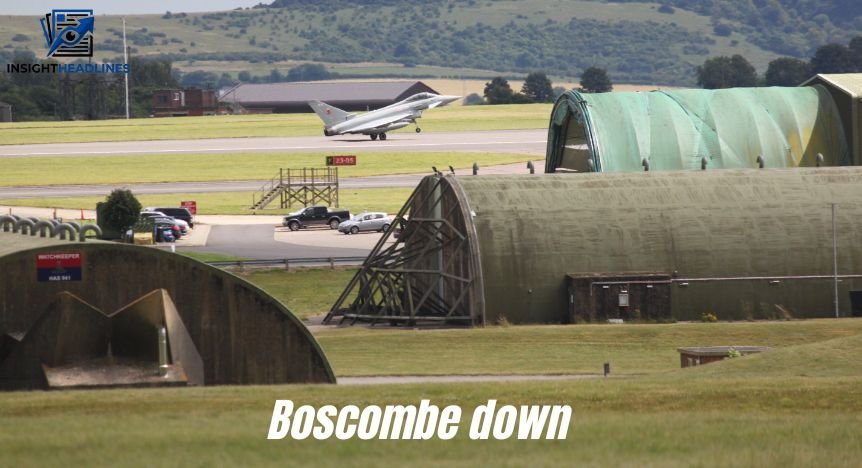
Searching for Boscombe Down can lead to several different topics: the weather forecast, a military airfield in Wiltshire, the history of RAF Boscombe Down, or the mysterious incident reported in 1994. There is also a visitor attraction with a similar name, the Boscombe Down Aviation Collection, which is often confused with the military base.
The important thing is to understand that these are connected by aviation history but are not all the same place. MOD Boscombe Down is an active military aircraft test and evaluation site near Amesbury. The aviation collection, meanwhile, is a public museum at Old Sarum Airfield near Salisbury.
This guide explains where Boscombe Down is, what happens at the airfield, how to check the Met Office forecast, and what is actually known about the reported 1994 crash. It also covers the museum, its visitor arrangements and the difference between the historic RAF station and its present-day MOD role.
Where Is Boscombe Down?
Boscombe Down is in Wiltshire, South West England, near Amesbury and Salisbury. The military airfield is situated a short distance from Amesbury and is associated with the wider Salisbury Plain area.
Its location is important because the surrounding region has a long military history. Salisbury Plain is home to several defence training areas and military establishments, making Boscombe Down a significant part of the UK’s aviation and defence landscape.
People searching for “where is Boscombe Down” may be looking for one of two places:
- MOD Boscombe Down: The military airfield used for aircraft testing and evaluation.
- Boscombe Down Aviation Collection: A public aviation museum located at Old Sarum Airfield, near Salisbury.
These are separate sites. The museum is not inside the military airfield, and visitors should not assume that a museum ticket provides access to MOD Boscombe Down.
What Is MOD Boscombe Down?
MOD Boscombe Down is a military aircraft test and evaluation establishment in Wiltshire. It is used to assess aircraft, aviation systems and equipment for the UK armed forces.
The site is particularly important because it provides facilities for testing aircraft performance, handling, safety and operational capabilities. Before military aircraft or equipment can be fully accepted for service, they may need extensive evaluation under controlled conditions.
The Ministry of Defence describes the station as the tri-Service home of military aircraft Test and Evaluation. This means its work supports the Royal Navy, British Army and Royal Air Force rather than serving only one branch of the armed forces.
The site is managed under a long-term partnership between the Ministry of Defence and QinetiQ. QinetiQ operates the airfield and specialist test facilities and provides technical expertise and support.
What Happens at MOD Boscombe Down?
The work carried out at Boscombe Down is different from the everyday activity of a conventional operational airbase.
Its main responsibilities include:
- Testing military aircraft and aviation equipment.
- Evaluating aircraft handling and performance.
- Supporting the development of defence technology.
- Conducting specialist trials.
- Providing technical expertise for military aviation.
- Assessing equipment before it enters or continues in operational service.
This work can involve aircraft from different services and a variety of specialist organisations.
A useful distinction: Aircraft testing is not simply about seeing whether an aircraft can fly. Evaluation can involve examining how it behaves in different conditions, how its systems perform, how it responds to operational demands and whether it meets the required safety standards.
RAF Boscombe Down: History and Development
Boscombe Down has a history stretching back more than a century.
The airfield first opened in October 1917 as a Royal Flying Corps training depot station. Its early purpose was to train aircrews for service during the First World War.
After the war, the site was used for aircraft storage before returning to agricultural use for a period. It reopened in 1930 as a bomber station.
Its role changed significantly in 1939 when the Aeroplane and Armament Experimental Establishment (A&AEE) moved there from RAF Martlesham Heath in Suffolk.
This move established Boscombe Down as a major centre for British aircraft research, testing and evaluation.
Important Aircraft Tested at Boscombe Down
The airfield has been connected with several important developments in British aviation.
Aircraft associated with pioneering work at the site include:
- English Electric P1, the experimental aircraft that led to the Lightning.
- Folland Gnat and Midge.
- Hawker P.1067, the prototype for the Hawker Hunter.
- Westland Wyvern.
- BAC TSR.2.
These projects demonstrate why Boscombe Down is important to aviation history. Its contribution was not limited to operating aircraft; it helped assess and develop aircraft that influenced British military aviation.
From RAF Station to MOD Boscombe Down
The site’s organisational structure changed over time.
In 1992, the establishment was renamed the Aircraft and Armament Evaluation Establishment (AAEE). Experimental work later moved through different defence research organisations.
In 1995, the Defence Evaluation and Research Agency (DERA) took responsibility for the work. Following the creation of QinetiQ in 2001, the airfield and its infrastructure came under the long-term partnership arrangement with the Ministry of Defence.
Today, the name MOD Boscombe Down reflects its continuing role in defence testing and evaluation.
Boscombe Down Weather: What Is the Forecast?
Weather is an important consideration around Boscombe Down, particularly because the area is associated with aviation activity.
People searching for Boscombe Down weather may want to know whether conditions are suitable for travelling, outdoor activities or simply understanding the local forecast.
The Met Office provides a dedicated forecast for Boscombe Down in Wiltshire.
Current Weather on 4 November 2026
The Met Office forecast for Wednesday, 4 November 2026, reports:
| Weather detail | Forecast |
|---|---|
| Maximum temperature | Around 9°C |
| Minimum temperature | Around 7°C |
| General conditions | Overcast |
| Sunrise | 7:05am |
| Sunset | 4:35pm |
The wider South West England forecast describes a cloudy start, with some brighter spells developing in places. Temperatures are expected to feel rather cool in the easterly breeze.
Weather can change during the day, so check the latest hourly forecast before travelling or making outdoor plans.
How to Read the Met Office Boscombe Down Forecast
A forecast is more useful when you understand the details rather than looking only at the temperature.
Pay attention to:
- Temperature: The maximum and minimum help you decide what clothing to wear.
- Feels-like temperature: Wind can make conditions feel colder than the actual air temperature.
- Rain probability: This indicates the chance of rainfall during a particular period.
- Wind speed and gusts: Gusts can be more important than average wind speed, particularly around exposed locations.
- Visibility: Mist and fog can affect travel and aviation conditions.
One detail worth remembering is that a general town forecast is not the same as an official aviation weather report. Pilots and aviation operators use specialist meteorological information, including visibility, cloud base, wind and other operational conditions.
For ordinary visitors, the standard Met Office forecast is usually sufficient for planning a journey.
Met Office Boscombe Down: Why Is It Useful?
The Met Office forecast for Boscombe Down gives a local view of conditions around the airfield.
This can be more useful than checking a broad forecast for Wiltshire because local weather can vary across the county. A forecast for Salisbury city centre, for example, may not perfectly represent conditions at a more exposed location near the airfield.
For anyone travelling to the area, the forecast can help with practical decisions:
- Whether to carry waterproof clothing.
- Whether to expect cold or windy conditions.
- How much daylight remains for an afternoon visit.
- Whether rain could affect outdoor plans.
- Whether to allow extra time for a journey in poor weather.
The Met Office also provides hourly forecasts and a longer outlook. However, confidence generally decreases further into the future, so short-range forecasts are more useful for decisions about a specific day.
The Boscombe Down Incident: What Happened in 1994?
One of the most frequently discussed stories connected with the airfield is the alleged Boscombe Down crash of September 1994.
The story has attracted interest because reports described an unidentified aircraft, unusual security activity and a possible connection with a secret American aircraft programme.
However, the incident remains disputed. It is important to separate reported eyewitness accounts from confirmed official information.
The Reported Incident on 26 September 1994
According to aviation reporting, an unusual event allegedly took place at Boscombe Down on the evening of September 26, 1994.
The reports described an aircraft experiencing a problem during take-off on Runway 23. Witness accounts later discussed in aviation publications included claims that:
- The runway was closed following the incident.
- An aircraft was covered with tarpaulins.
- Emergency vehicles were present.
- The aircraft was moved into a hangar.
- A large American military transport aircraft later visited the airfield.
Some reports suggested that the aircraft may have been a highly classified stealth or reconnaissance design.
The story became particularly well known after a 1997 report in Air Forces Monthly discussed the alleged incident.
Was It a Secret American Spy Plane?
Theories about the aircraft included references to projects known as ASTRA and Aurora.
These names have been associated with speculation about classified American reconnaissance aircraft. However, no publicly confirmed evidence has established that an Aurora or ASTRA aircraft crashed at Boscombe Down.
The mystery became more popular because the alleged aircraft was never publicly identified and the reports included claims of unusual security arrangements.
It is important not to confuse a theory with a verified aircraft identification.
What Did the British Government Say?
A particularly important piece of evidence comes from a written parliamentary answer dated December 1, 1994.
In response to a question about an alleged air crash at Boscombe Down on September 26, the defence minister said that staff at the site had confirmed there had been no crash at the unit on that date, or indeed during that year up to that point.
The answer added that the only flying that took place that night was the launch of two Royal Navy Sea King helicopters in support of an exercise.
This is the official parliamentary response and should be included whenever the alleged crash is discussed.
The fact that aviation publications and witnesses described unusual activity does not establish that a secret aircraft crashed. Equally, the public discussion has continued because some journalists and witnesses have disputed the official explanation.
The most accurate conclusion: The alleged 1994 Boscombe Down crash remains an unresolved aviation story in public discussion. There is no publicly confirmed identification of a crashed secret aircraft, and the Ministry of Defence’s parliamentary response denied that a crash had occurred.
Boscombe Down Aviation Collection: Is It the Same as the RAF Airfield?
No. The Boscombe Down Aviation Collection is a separate public museum at Old Sarum Airfield, near Salisbury.
This is one of the most common sources of confusion for people searching for Boscombe Down. The museum’s name refers to the area’s aviation history, but it is not located inside the MOD military establishment.
The collection preserves aircraft, cockpit exhibits and aviation artefacts. It is particularly interesting for visitors who want to explore British military aviation and aircraft development without needing access to an active defence site.
What Can You See at the Aviation Collection?
The museum features a range of exhibits connected with aviation history, including:
- Harrier and other military aircraft cockpit displays.
- Jaguar, Tornado and Lightning-related exhibits.
- A de Havilland Comet C.2 forward fuselage exhibit.
- Helicopters and training aircraft.
- Royal Flying Corps historical displays.
- Engines, ejection seats and aviation equipment.
- Flight simulators and restoration projects.
One of its distinctive attractions is the opportunity to get close to selected aircraft cockpits. Visitors may be able to sit inside some of them, depending on access and safety arrangements on the day.
The collection also has volunteers who can explain the history and technical details of individual exhibits.
Boscombe Down Aviation Collection Tickets and Opening Times
The museum’s published standard admission prices are:
| Ticket | Standard price |
|---|---|
| Adult | £13.50 |
| Concession | £12.50 |
| Child aged 5–15 | £6.50 |
| Under 5 | Free |
| Family ticket | £31.50 |
Gift Aid admission prices are also available for eligible visitors.
Its seasonal opening schedule is:
- February to October: Tuesday–Sunday, 10am–5pm.
- November to January: Tuesday–Sunday, 10am–4pm.
- Mondays: Normally closed.
- Last entry: One hour before closing.
The museum is at Hangar 1 South, Old Sarum Airfield, Salisbury, Wiltshire, SP4 6DZ.
These are museum visitor arrangements, not opening times for MOD Boscombe Down. The military airfield is not a public museum and does not offer ordinary walk-in access.
Why Is Boscombe Down Important to British Aviation?
Boscombe Down has played a major role in the development and evaluation of British military aircraft.
Its importance comes from the work carried out behind the scenes. Aircraft must be tested and evaluated before they can be relied upon in demanding military environments.
The site has been associated with experimental aircraft, flight trials and technical assessment for decades. Its history connects the early Royal Flying Corps with modern defence research and evaluation.
Three details help explain its wider significance:
First, it is more than an RAF history site. Its work now supports all three UK armed services through military aircraft testing and evaluation.
Second, its contribution is often less visible than that of operational airbases. Testing and evaluation may not attract the same public attention as combat operations, but it helps establish whether aircraft and systems are suitable for service.
Third, its history is linked to aircraft that never became everyday service aircraft. Experimental designs such as the BAC TSR.2 show how test establishments can be connected to ambitious projects even when those projects do not enter full production.
FAQ
Where is Boscombe Down in the UK?
Boscombe Down is in Wiltshire, South West England, near Amesbury and Salisbury. The military airfield is known as MOD Boscombe Down and is used for military aircraft testing and evaluation. The public aviation museum with a similar name is at Old Sarum Airfield, near Salisbury.
Is RAF Boscombe Down still an active airbase?
The site remains active as MOD Boscombe Down, a military aircraft test and evaluation establishment. Its work supports the Royal Navy, British Army and Royal Air Force. It is managed under a partnership between the Ministry of Defence and QinetiQ.
What is the Boscombe Down weather forecast?
The Met Office provides a dedicated forecast for Boscombe Down in Wiltshire. On November 4, 2026, the forecast indicates overcast conditions, with a maximum temperature around 9°C. Check the latest hourly forecast for updated rain, wind and temperature information.
What happened at Boscombe Down in 1994?
Reports claimed that an unidentified aircraft had an incident during take-off on September 26, 1994. Some accounts suggested it may have been a secret aircraft, but no such identification has been publicly confirmed. A parliamentary answer in December 1994 stated that staff had confirmed no crash had occurred at the unit that night.
Can the public visit MOD Boscombe Down?
MOD Boscombe Down is an active military site, not a public aviation museum. Ordinary visitors should not expect access to its airfield or test facilities. People interested in aviation history can visit the separate Boscombe Down Aviation Collection at Old Sarum Airfield.
Is Boscombe Down Aviation Collection located at the RAF base?
No. The collection is at Old Sarum Airfield, approximately two miles north of Salisbury. It is a separate public museum with its own admission prices and opening times. The museum specifically advises visitors that it is not located on MOD Boscombe Down Airfield.
Conclusion
Boscombe Down is an important part of British aviation history, but the name covers several subjects that are easy to confuse. MOD Boscombe Down is an active military aircraft test and evaluation site, while the Boscombe Down Aviation Collection is a separate public museum at Old Sarum Airfield near Salisbury.
The airfield’s history dates back to 1917 and includes major aircraft development and testing. Its reported 1994 incident remains a subject of aviation speculation, although the official parliamentary response denied that a crash had occurred.
For visitors, the museum offers a way to explore the area’s aviation heritage. For anyone checking local conditions, the Met Office provides a dedicated Boscombe Down forecast. Understanding the difference between these places makes it much easier to find the right information.